Read the Bible, You Heathen
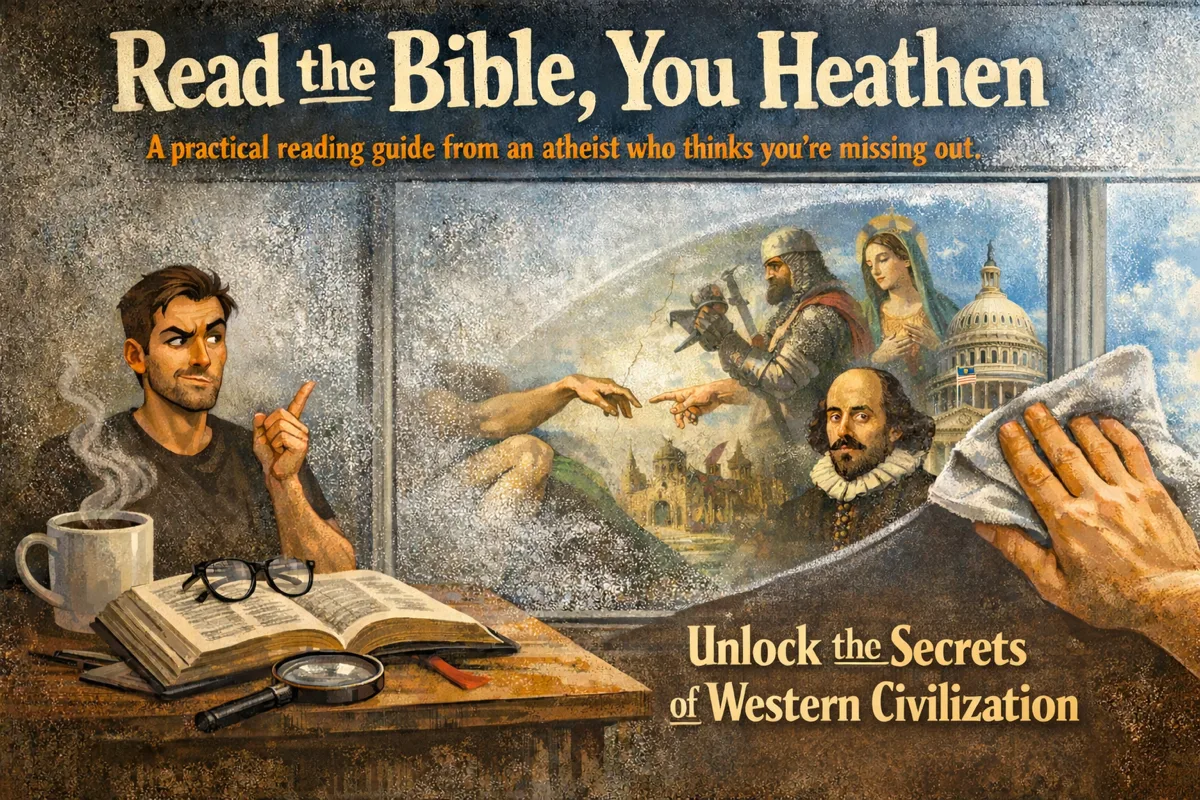
I’m an atheist, and I’m telling you to go read the Bible. Not because I want you to find Jesus, that’s not my intention. You do you... I’m telling you to read it because the Bible is the secret decoder ring of Western civilization. If you haven’t read it, it is like having half of the art, literature, politics, and language of the last two thousand years hidden behind frosted glass.
You REALLY can’t read Milton, Dante, Dostoevsky, Faulkner, or Toni Morrison without the Bible sitting on the shelf next to them. The same goes for a Renaissance painting, a Bach cantata, a Coen brothers movie, or what Lincoln is doing at Gettysburg. Every time someone says “a drop in the bucket” (Isaiah 40:15), or “the writing on the wall” (Daniel 5:5), or “by the skin of my teeth” (Job 19:20), they’re quoting the Bible. Coolio rapped Psalm 23 and it went to number one. Pete Seeger set Ecclesiastes 3 into a song and the Byrds made it a hit. Leonard Cohen’s “Hallelujah” namechecks Bathsheba; that’s 2 Samuel 11. Hemingway pulled The Sun Also Rises out of Ecclesiastes. Steinbeck built East of Eden on Cain and Abel. Every “shining city on a hill” is Matthew 5:14. When Bob Marley sings about Babylon, that’s Psalm 137. This isn’t about faith, it’s about literacy.
For about fifteen hundred years the Bible was basically the only shared text in the Western tradition, and every writer, painter, composer, and statesman was working with the same material, making references and jokes and arguments that assumed you’d read it too. If you haven’t, you’re walking around a museum with half the paintings in the dark. That’s a shame, and it’s an especially silly one when it happens to people who love books and art and who’ve decided the Bible is for the other team. It isn’t. It’s for everyone who wants to know where the West got its defaults.
So why do smart, curious, well-read secular people keep bouncing off this book like it’s radioactive? I have some theories, and every one of them has a bad reason dressed up as a good one.
The usual story is that they grew up around bad Christians, or boring ones, and somewhere along the way they confused the book with the people who’ve been loudest about it. That’s a category error. I don’t stop reading Nietzsche because some undergrad in a trench coat ruined him for me, and I don’t stop reading Marx because of the boorish loudmouth at a party. You’re allowed to separate the text from its worst practitioners.
Then there’s the assumption that the Bible is all rules and smiting and genealogies and thou-shalt-nots. Sure, there is some of that. But you can skip those parts. This isn’t a novel where you have to read every single page in order or the plot falls apart. Consider it more like a library. Ancient people decided to bind a library together and called it a single book, and we’ve been pretending it reads like one ever since. It doesn’t. Some of it is history, some is poetry, some is philosophy, some is myth, some is erotica (more on that later), and some is just lists of who begat whom. You can safely skim those. There is no genealogical test and the book is not going to punish you.
Finally, there’s the sheer physical intimidation of the thing. It’s a doorstop with weird names and footnotes that point to other footnotes. Everyone who picks it up and tries to read it from cover to cover like a Tom Clancy novel quits somewhere in Leviticus, concludes they’re not smart enough, and never opens it again. That’s not a you problem. That’s a bad reading plan.
So, let’s fix that. First, a disclaimer: this is MY pragmatic reading plan, and various camps will disagree. A literature prof would flip the testaments to emphasize how they mirror each other. Evangelicals won’t like skipping Leviticus (I told you I was an atheist, right?). Catholics will want more Wisdom of Solomon and Sirach (Ecclesiasticus.) Jewish scholars would object to how I frame the Old Testament as setup for the New, and if that’s you, use the Jewish Study Bible I recommend below and add Jeremiah to your list. Orthodox readers would treat the Septuagint as inspired text. All fair. I can defend my choices, but you should know where I’m coming from. Now, ἄγωμεν!
First, get the right translation.
You want the New Revised Standard Version (NRSV), or its updated edition the NRSVue (2021), which is the version the academic presses are migrating to. It’s the ecumenical translation, which means that many of the denominations were involved. The NRSV is based on the best manuscripts, and it’s what both of the study Bibles I’m about to recommend are built around. If you’re reading the Bible as literature and history, this is the one.
The English Standard Version (ESV) and the New International Version (NIV) are both fine if you happen to have either one on your shelf. ESV is more word-for-word and preserves the underlying structure; NIV is smoother and more readable. Both come out of evangelical Protestant translation teams, and the ESV in particular has some documented tilt in how it handles gendered language. Readable, but not neutral. Start with the NRSV.
NERD ALERT: this is maybe the single best recommendation in this whole essay, if I do say so myself. If you’re reading the Old Testament as literature, get Robert Alter’s The Hebrew Bible (2018). Alter (fellow nerd) spent decades single-handedly translating the entire Hebrew Bible specifically to preserve the rhythm, compactness, and wordplay of the Hebrew. It reads like a literary text, not something flattened by group consensus. Even the introduction is amazing. Think of it like this: the NRSV is your whole-Bible workhorse (Old Testament and New), and Alter is what you reach for when you want the Hebrew Bible to sound like the literature it is. Run them side by side on the Old Testament and you’ll see what got smoothed over. If you take to his style, the companion books The Art of Biblical Narrative and The Art of Biblical Poetry are the best short education you can get in how these books work as literature.
That said, DO NOT START WITH THE KING JAMES BIBLE. Yes, it is beautiful, and yes, the prose sounds like God is narrating a Ken Burns documentary. This is what I grew up on, but the language is English from four hundred years ago. More importantly, the KJV it rests on a less complete manuscript base called the Textus Receptus This is the Greek text Erasmus assembled from a handful of late Byzantine manuscripts and was the standard until older Greek sources turned up. Go back and read the King James later, once you know the material. Just don’t use it as your on-ramp.
A quick note. Protestant Bibles have sixty-six books, Catholic Bibles have seventy-three, adding the deuterocanonicals (Tobit, Judith, Wisdom, Sirach, Baruch, 1-2 Maccabees, plus additions to Esther and Daniel), and the Orthodox canons go further still.1
Get the longer canon with the stories that are all over Western art, like Judith with Holofernes (Caravaggio, Donatello, Artemisia Gentileschi). You’ll miss these if your Bible stops at the Protestant table of contents.
Get a study Bible or an annotated edition. The two I’d direct you to are the HarperCollins Study Bible and the New Oxford Annotated Bible (5th edition, 2018). Both are built on the NRSV, both are the standard academic picks. Pick whichever you find cheaper or prettier. For the Old Testament specifically, grab the Jewish Study Bible (Oxford), which gives you the Tanakh as Jews read it, with notes from Jewish scholars. Without the notes, you’re reading a conversation with one side of it redacted.
(A note on the citations in this essay: for the famous idioms, I’ve kept the King James phrasing, not just because I like it (I do), but because that’s the version the English language absorbed. The NRSV is still what I’d recommend you read.)
Second, don’t start at the beginning.
I know what you are thinking. Every instinct says to open Genesis chapter one and read forward. Don’t do it! The Old Testament is a mountain, and if you put in enough effort, you’ll climb it eventually. But if you start there, chances are you’ll get bogged down in Levitical dietary law and conclude that this whole Bible reading project was a mistake.
Instead, start with the New Testament. For one, it’s shorter. It’s the part of the Bible that most of the Western canon is referencing. On top of that, it has a clean narrative spine: a guy is born, teaches, dies, and his followers start an argument that is somehow still going.
Here’s your New Testament reading order.
Luke. Start here. Of the four gospels, Luke has the cleanest prose, the best storytelling, and the most hits: the nativity, the Prodigal Son, the Good Samaritan, the crucifixion. Traditionally attributed to a physician writing for a gentile audience, and reputedly the best Greek of the four.
John. Read this one next. The other gospels (Matthew, Mark, Luke) are called synoptic because they’re telling more or less the same story the same way. John is the weird one out. The writing is more mystical, more philosophical, more concerned with who Jesus was than what he did. “In the beginning was the Word” (John 1:1) is here. If Luke tells you the story, John tells you what the story means.
Acts. Read this. Luke’s sequel, by the same author. After Jesus dies, the disciples get arrested, argue with each other, and spread around the Mediterranean. Paul’s conversion on the road to Damascus is here. This is where Christianity becomes its own thing instead of a Jewish sect with an unusual rebel rabbi.
Romans. Optional, for the theology. Paul laying out his dense but foundational argument. Paul sounds like late commentary but he’s the first voice on the page: his letters are the earliest writing in the New Testament. Paul died around 64-65 CE (by tradition, under Nero), Mark wasn’t written until about 70 CE, and the others came later.2
Revelation. Definitely read. The apocalypse. Yes, the one with the Four Horsemen, the Whore of Babylon, the Beast, the number of the Beast, and the new Jerusalem descending from heaven. It’s all here, and it’s where every apocalyptic image in Western art and pop culture comes from. It reads like a fever dream. That’s the point.
You can skip most of the letters (the Epistles) unless you want more theology, with one exception: 1 Corinthians 13 (”love is patient, love is kind”) is quoted at basically every Anglophone wedding you will ever attend, so give that chapter a look on its own.
As for the other gospels, Mark you can circle back to later. If you come back to read one thing, make it Matthew 5-7, commonly called “the Sermon on the Mount.” In these three chapters is where you’ll find: the Beatitudes, “salt of the earth,” “turn the other cheek,” “do not cast your pearls before swine,” and the Lord’s Prayer! After reading Luke and John for the story, Matthew 5-7 is where a huge share of the quotable material lives.
As you read, remember the Bible that Paul and Matthew and the rest of these authors quoted was itself a translation. The Septuagint is a Greek rendering of the Hebrew scriptures done in the third and second centuries BCE, and when a New Testament author quotes the Old Testament, he is almost always quoting the Greek, not the Hebrew. This can cause a few issues, the most major being Matthew’s famous line “a virgin shall conceive.” That’s the Septuagint’s parthenostranslating the Hebrew almah, which simply means “young woman.” So, in Isaiah, it’s a young woman. But in Greek, she turns into a virgin. Matthew, reading the Septuagint (in Greek), points at that verse as prophecy fulfilled by Mary, and the doctrine of the virgin birth grew out of that one word swap. So in terms of philology, this is super interesting, but this single difference in translation has spawned religious sects and church dogma.
That’s it for the New Testament. You can do it in a few weeks of evenings.
Third, the Old Testament: cherry-pick, don’t grind.
The Old Testament is longer, older, stranger, but more rewarding in some ways. It’s also where most of the culturally famous stories live. However, it is sprawling, and if you try to read it front-to-back you may die in a desert of Mosaic law somewhere around Numbers.
Before you dive in, know that the Christian Old Testament isn’t ordered the way Jews read the same material. The Hebrew Bible, called the Tanakh, is arranged in three parts (Torah, Nevi’im or Prophets, Ketuvim or Writings), and it ends with Chronicles, not with Malachi. The Christian reordering puts the prophets last because Christians read the prophets as predicting the messiah. In that case, you’d want the last word of the Old Testament to be pointing at the arrival of Jesus at the top of the New Testament... That is a theological argument baked into the table of contents. Keep it in mind when you pick up your study Bible and wonder why the same books are in a different sequence.
Here’s what to read and what to skip.
Genesis. Read it. This is the one with the creation, the garden, the flood, the tower of Babel, Abraham, Isaac, Jacob, and Joseph and his coat. Skim the genealogies, the “and so-and-so begat so-and-so” sections. I promise, you don’t need them. The stories between them are foundational. Half of Western art is illustrations of Genesis.
Exodus. Read Chapters 1-20 and 32-33. That’s Moses, the burning bush, the plagues, the parting of the Red Sea, the Ten Commandments, and the golden calf. The rest of Exodus is instructions for building a tabernacle in exacting detail. Cool, but skippable unless you’re really into ancient Near Eastern design.
Leviticus, Numbers, Deuteronomy. Mostly skim. It’s legal code, and it’s a slog unless you’re a biblical scholar or a rabbi. BUT don’t dump the whole pile: Jesus quotes these books constantly, and the two halves of what he calls the Great Commandment come out of them. Deuteronomy 6 is the Shema (”Hear, O Israel, the Lord our God, the Lord is one”), which is the central daily prayer of Judaism and has been for thousands of years, and Leviticus 19:18 is “love your neighbor as yourself.” Know where those come from. Moses’s farewell in the last chapters of Deuteronomy is also worth a read.
Joshua and Judges. Skim. Joshua has the battle of Jericho (chapter 6: walls, trumpets, you know the bit). Judges is tribal-era Israel at its most violent and weirdest, and it has Samson and Gideon in it (Judges 13-16 for Samson). Read those parts.
Ruth. Read. Short, sweet, and it is probably skippable, but it sets up David.
1 and 2 Samuel. Read these. This is where the Old Testament gets great. David’s rise (David and Goliath in 1 Samuel 17) and then David as king, which is one of the most honest portraits of power, adultery, grief, and political failure in ancient literature. Shakespeare read and internalized this. You can tell.
1-2 Kings, 1-2 Chronicles. Read until bored, then bail. It’s a long parade of kings, most of them bad at the job, ending with Israel getting conquered. Solomon shows up, builds the Temple, the kingdom splits, and then it’s name after name after name. The one entry worth stopping for is Elijah (1 Kings 17-19): the ravens feeding him, the contest on Mount Carmel, the still small voice. Chronicles is a rewrite of the same material with the politics sanded off.
Ezra, Nehemiah. Skip.
Esther. Read it. It’s short, it’s a political thriller, there’s a Jewish woman in a Persian court outmaneuvering a genocidal vizier. Great story.
Job. Read it. It’s weird and poetic and philosophical: a man loses everything and argues with God about why. The answer God gives him is one of the strangest passages in any ancient text. You will think about it for years.
Psalms. Read, but not necessary to read it front to back. It’s a hymnal: one hundred and fifty ancient poems, traditionally attributed to David, though in practice written by many hands over centuries. Dip in. Try 23 (”The Lord is my shepherd,” Psalm 23:1), 51, 88, 137 (”By the rivers of Babylon,” Psalm 137:1), 139. The Psalms are where the Bible’s poetic register lives, and they’re where half of English devotional poetry comes from.
Proverbs. Dip in. Read a chapter when you feel like it Aphorisms from Solomon. It’s the ancient Near Eastern version of a book of wisdom quotes, and it’s better than most of them.
Ecclesiastes. Read the whole thing. It’s short, and it’s one of the most remarkable pieces of philosophy in antiquity: a king, in old age, looking back at his life and concluding that most of what humans chase is vanity. “There is nothing new under the sun” (Ecclesiastes 1:9) is here. So is “a time to be born and a time to die” (Ecclesiastes 3:2). It reads like it was written last week, by someone who is very very tired.
Song of Solomon. Read it. I told you we’d get to this. It’s erotic poetry in the Bible. Two lovers describing each other’s bodies in lush agricultural metaphor, and its inclusion in the canon is one of the more interesting theological puzzles of the last two thousand years.
The Prophets. There are a lot of them and most of them are hard going. If you read one, read Isaiah. Handel’s Messiah leans on Isaiah more than any other book. It’s where “they shall beat their swords into plowshares” (Isaiah 2:4) comes from, and “unto us a child is born” (Isaiah 9:6), and “a voice crying in the wilderness” (Isaiah 40:3). Some of the most cited poetry in the language. If you want to read another, Amos is a great second. MLK quoted this verse at the March on Washington and again from the Birmingham jail: “let justice roll down like waters, and righteousness like an ever-flowing stream” (Amos 5:24). It has been the backbone of Anglophone political rhetoric about justice ever since. Read the chapters around it for the context.
Daniel. Read it, and not just because it is my name. It’s half narrative and half apocalyptic vision. The lions’ den, the fiery furnace, the writing on the wall, all Daniel. The visions toward the end of the book are what Revelation in the New Testament is riffing on a few centuries later.
Jonah. Four chapters. Guy gets swallowed by a fish. You know this one. Read it anyway. It’s funnier and stranger than you remember.
This is the TLDR version. If even the cherry-picked list feels like too much, here’s the absolute minimum:
New Testament: Luke, John, Acts, Revelation, Matthew 5-7.
Old Testament: Eden (Genesis 1-3), Cain and Abel (Genesis 4), Noah (Genesis 6-9), Babel (Genesis 11), Abraham and Isaac (Genesis 22), Jacob’s ladder (Genesis 28), Joseph (Genesis 37-50), the burning bush and the Exodus (Exodus 1-20), Jericho (Joshua 6), Samson (Judges 13-16), David and Goliath (1 Samuel 17), David and Bathsheba (2 Samuel 11), Elijah (1 Kings 17-19), Job, Ecclesiastes, Isaiah 2, 9, and 40, Amos 5, Daniel, Jonah.
About two hundred pages. A month of evenings. You’ll emerge with a reference library in your head that unlocks thousands of works of art you only half-understood.
The Bible is not a novel. It’s the compiled, edited, argued-over, translated-and-retranslated record of a people trying to work out who they were and what they owed each other and what, if anything, was watching. It is the story of God’s relationship with humanity. You don’t have to believe the God part for the humanity part to be worth your time. The humans in this book are doing what humans do. They spend their time loving, screwing up, killing each other, forgiving each other, trying to be better, failing, and singing about it.
I guarantee that if you start reading the Bible, the frosted glass will begin to come off and the lights in the museum will come on. That’s the prize that’s been sitting quietly and waiting for you the whole time...
For a readable overview of how the canons took shape, see Lee Martin McDonald, The Biblical Canon: Its Origin, Transmission, and Authority (Hendrickson, 2007). The introductions to the HarperCollins Study Bible and the New Oxford Annotated Bible also summarize the history.
↩The traditional date for Paul’s martyrdom under Nero comes from Eusebius’s Ecclesiastical History. For a standard scholarly treatment of New Testament dating, see Bart Ehrman, The New Testament: A Historical Introduction to the Early Christian Writings (Oxford University Press).
↩
This essay first appeared on Daniel’s Substack.